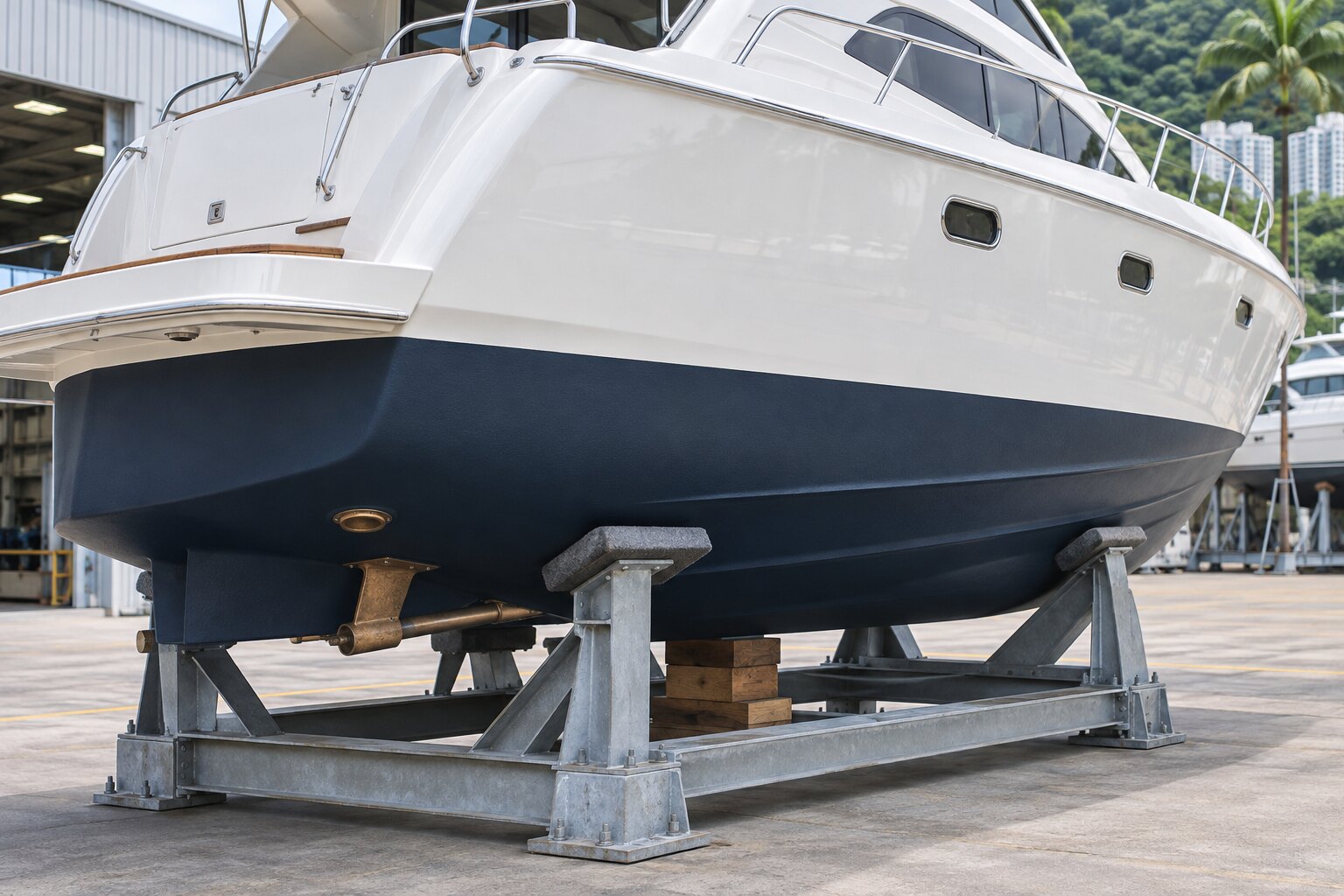

Haul-out illustration showing the waterline and the dark antifouling below it.
For a motor yacht or sailing yacht kept afloat, book one haul-out a year as a starting point. Budget for two if the boat repeatedly develops extensive hard growth within six months, or if a busy charter boat has had recurring underwater hull problems. A trailer boat or dry-stack boat recovered after each outing usually needs no extra lift solely for antifouling. Treat lifts and full recoats as separate decisions. The condition of the paint after washing determines whether the yard should clean, patch or recoat the bottom.
How many lifts should you plan for your type of boat?
Use this first-year schedule to budget and reserve yard time, then adjust it with evidence from your boat. Month 3 or 6 means after the last clean or recoat. Where local and berth rules permit, arrange underwater photographs through the yard or a qualified diver before deciding whether to lift again.
| Boat and use | Lift allowance | Checks during the year |
|---|---|---|
| Private motor yacht kept afloat, used one to several times a month | One lift a year. | At month 6, photograph the waterline, both sides, stern, propellers and intake grilles. If there is only a thin film and sound paint, keep the annual booking. |
| Cruising sailboat or catamaran kept afloat | One lift a year. | At month 6, check the keel or mini-keels, rudders, propellers and saildrives. Photograph both catamaran hulls, particularly the inner faces. Bring work forward if hard growth or flaking develops. |
| Little-used boat in a berth with a history of rapid fouling | One scheduled lift. Reserve a second if past records show extensive hard growth or coating failure within six months. | Check the waterline, bottom and stern at month 3 and again at month 6. Release the reserved slot if there is still only a thin film. Bring the lift forward for extensive barnacles, flaking paint or abnormal underwater gear condition. |
| Fast boat, busy charter yacht or racing sailboat kept afloat | One scheduled lift. Reserve a second if fouling or worn-through paint has disrupted normal use within six months. | Before the busy or racing season, inspect propellers, rudders, intakes and stern gear. On a motor yacht record speed at a familiar RPM and maximum achievable RPM. If either consistently departs from its own baseline, have the yard check the propellers, fishing line and engine as well. |
| Trailer boat or dry-stack boat recovered after each outing | Zero extra lifts solely for antifouling. | Inspect at recovery and rinse to the maker’s instructions. Look at grilles, outboards and trailer contact points. Reassess before leaving the boat afloat for several weeks or a season and inspect the whole bottom at recovery. |
Two examples. A 45-foot private motor yacht kept afloat and used twice a month can schedule underwater photographs at month 6 and a lift at month 12. Thin slime at the half-year check can leave that plan intact. A comparable charter yacht that had widespread hard growth and clogged grilles within five months of painting should schedule a month-3 check and provisionally reserve a midyear yard slot. If intake grilles clog again or the engine shows a cooling alarm, stop using the boat and arrange prompt inspection.
How many full recoats should you budget for? With a single-season paint, allow for one full recoat in the annual quote. With documented multi-season paint, wash and inspect at the annual lift. If the coating is sound, effective and still within the planned service schedule, leave the recoat for the next cycle. Even when a boat needs two lifts in a year, plan the second around the inspection findings. It may need only a wash or local repairs.
Season, coating condition and time afloat all affect growth, even in one berth. Photograph the same locations each time to distinguish recurring local wear from widespread growth. IMO guidance on recreational craft biofouling

What should the yard do once the boat is ashore?
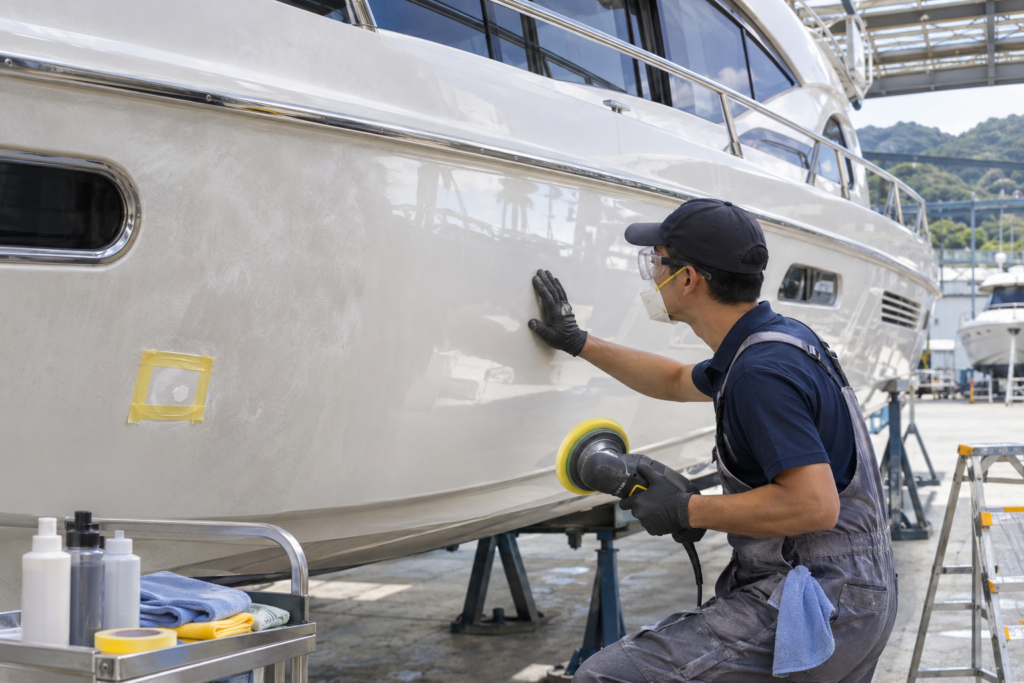
- Photograph before and after washing. Record the distribution of growth before washing. After cleaning and appropriate drying, photograph both sides, the bottom, waterline, keel, rudders, grilles, propellers and shafts. Use a yard area where wash-water and paint debris can be collected. Remove hard growth where necessary, taking care to preserve sound underlying coatings.
- Decide the scope from the coating condition. Sound, effective paint that is not due for recoating under the product instructions or job scope can be washed and recorded. For isolated wear or loose edges, mark the area, remove failing paint, feather sound edges where appropriate, and spot-prime and patch with compatible products. If widespread hard growth persists after washing, sheets of paint lift, or built-up layers fail, establish the cause and removal depth before quoting a full antifouling job. Blisters originating in the gelcoat or substrate need their own diagnosis.
- Check paint compatibility before ordering. Ask for the full names of the current and proposed coatings. Where the old paint is unknown or incompatible, use the specified sealer only if the system explicitly permits it and the existing coating is sound. Remove broadly failing layers. Use the preparation method and protective measures required for the specified system.
- Specify the hull and underwater gear separately. Hull paint should only go on propellers, shafts, aluminium drives, saildrives or stern thrusters when explicitly suitable. Match the coating to the substrate and maker’s instructions. Protect anodes, sensors and intakes. Leave anodes unpainted. Have abnormal valves, hoses or other components inspected and priced separately.
International antifouling data sheet · Interlux underwater gear painting guide

How do you choose paint and set the relaunch date?
For cruising boats kept afloat, ask about a self-polishing product suitable for extended stationary periods and compatible with the existing system. Its surface gradually wears to expose fresh active coating. For fast or racing boats that need a smooth finish, compare hard coatings. Ask about suitable speed, permitted cleaning and how to remove accumulated layers. For boats often stored dry that need paint, confirm how long the finished coating can stay ashore and what preparation it needs before relaunch. Use a system explicitly approved for aluminium where applicable. In Hong Kong, ask the yard to check the AFCD registration information for biocidal antifouling. Hard coating example · Storage and relaunch guide · AFCD antifouling information
Put paint quantity, film thickness and timing in the quote. The yard should specify hull area, the primer and topcoat, quantity, number of coats, application method and any stripe coat for the waterline, keel and rudder edges. In one roller-applied schedule for International Micron 350, the data sheet specifies two coats at 60 microns dry each for 12 months and three at 60 microns each for 24 months. Those are application specifications for that product. Keep the haul-out or inspection schedule for the boat.
Example relaunch calculation. At 23°C the same sheet specifies at least six hours before recoating with the same paint and at least ten hours from the final coat to immersion. Assuming the hull has been prepared and conditions stay within the product requirements, if coat one is finished at 8 am, coat two can start no earlier than 2 pm. If the final coat finishes at 4 pm, the calculated earliest immersion is 2 am the following day. A morning lift-in can be practical after confirming the film is hard dry and conditions are suitable. Recalculate when the product, temperature, coat count or repairs change. Micron 350 technical data sheet

What should the owner receive at handover?
- Job photos. Before washing, after washing, after repairs and on completion, all at the same locations. Document coating over support-pad areas. Include the last touch-up in the relaunch timing.
- Coating record. Product, batch, actual quantity, film or application record, final application time and earliest relaunch time. Agree the location, reason and cost of added stripping or substrate repair before it is done.
- Checks on relaunch. Have the yard or captain confirm the condition of underwater openings and seals and check that engine cooling is normal. Arrange appropriate tests if the intakes or propulsion gear were worked on. During a sea trial, record speed, vibration and unfamiliar noise at comparable load, sea state and RPM for the next inspection.
When obtaining a quote from a Hong Kong or Jinwan yard, give the boat type, length, propulsion, storage, typical cruising frequency, last lift date and paint name. Ask for separate prices for haul-out and wash, local repairs or a full recoat, underwater gear work and relaunch tests. VOY’s Jinwan haul-out and hull maintenance service