

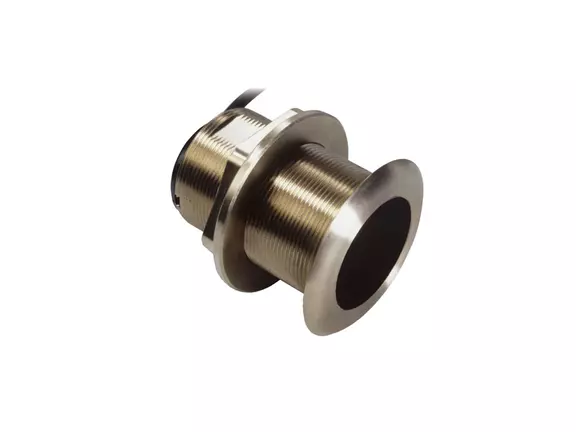
A depth sounder tells you how deep it is beneath the boat, but first establish where the measurement starts. At the same location, a display may show depth from the waterline, transducer or keel. Understanding that reference matters more than reading the number alone.
A transducer sends sound and receives the seabed echo
A transducer converts an electrical signal into sound transmitted into the water. The seabed reflects it back, and the system uses the round-trip travel time to calculate distance. This is the basic idea of echo sounding. The display presents the resulting number.
The transducer measures; the screen displays data. Several screens can use the same depth source, so each screen does not necessarily have a separate transducer.

Why do the three depth references matter?
The transducer is usually below the waterline and may sit above the boat’s lowest point. Without an offset, its measurement starts at the transducer face. A depth offset lets the system express another reference.
For a conceptual example only: the water is 6 metres deep from the surface, the transducer is 1 metre below the surface, and the vessel’s lowest point is 2 metres below it. The three distances are therefore 6, 5 and 4 metres. They describe the same water with different starting points. These are not measurements from a vessel or a safe-navigation standard.
| Display reference | Example | Distance represented |
|---|---|---|
| Waterline | 6 m | Water surface to seabed |
| Transducer | 5 m | Transducer face to seabed |
| Vessel’s lowest point | 4 m | Vertical clearance below that point |
Where can a transducer go on an inboard yacht?
Common arrangements include through-hull mounting, transmitting from inside a suitable solid-fibreglass hull, and transom mounting. The choice depends on hull material, propulsion and water flow; a transom-mounted unit is not suitable for every vessel.
Raymarine’s selection guidance identifies through-hull options for inboard and high-speed boats. An in-hull unit needs an appropriate solid-fibreglass sound path. These are installation choices to discuss with a technician, rather than instructions to drill or modify the hull. The actual product, position and display compatibility need checking.


Start with three checks
- Units: is the display using metres or feet?
- Reference: does depth start at the waterline, transducer or below the keel?
- Source: which transducer is selected, and is there a measured record of its offset?
Do not copy another brand’s plus or minus setting. Garmin and Raymarine present offset conventions differently. Follow the manual for the installed model, measure the relevant distance and verify the displayed result.
If readings disappear, jump or differ greatly from expectations, record the screen, boat speed and location, then arrange checks of the source, settings and installation. Conventional downward sounding provides information within its detection area; it does not establish that the entire channel ahead is clear. Continue to use charts, tides and a proper lookout.
Remember: establish where the number starts before interpreting clearance. VOY Yachting can help coordinate marine-instrument checks and maintenance. Include transducer and display model details with your enquiry.
Sources
- Raymarine:Traditional sonar technology;81432 Rev 2
- Raymarine:Depth transducer offset;81432 Rev 2
- Raymarine:Types of Transducers;2022-08-23
- Raymarine:Choosing a Transducer;2022-08-17
- Garmin GPSMAP:Setting the Keel Offset;GUID-413FE004… v13,2025-01
Checked 22 November 2026. Settings and installation depend on the actual model.


