
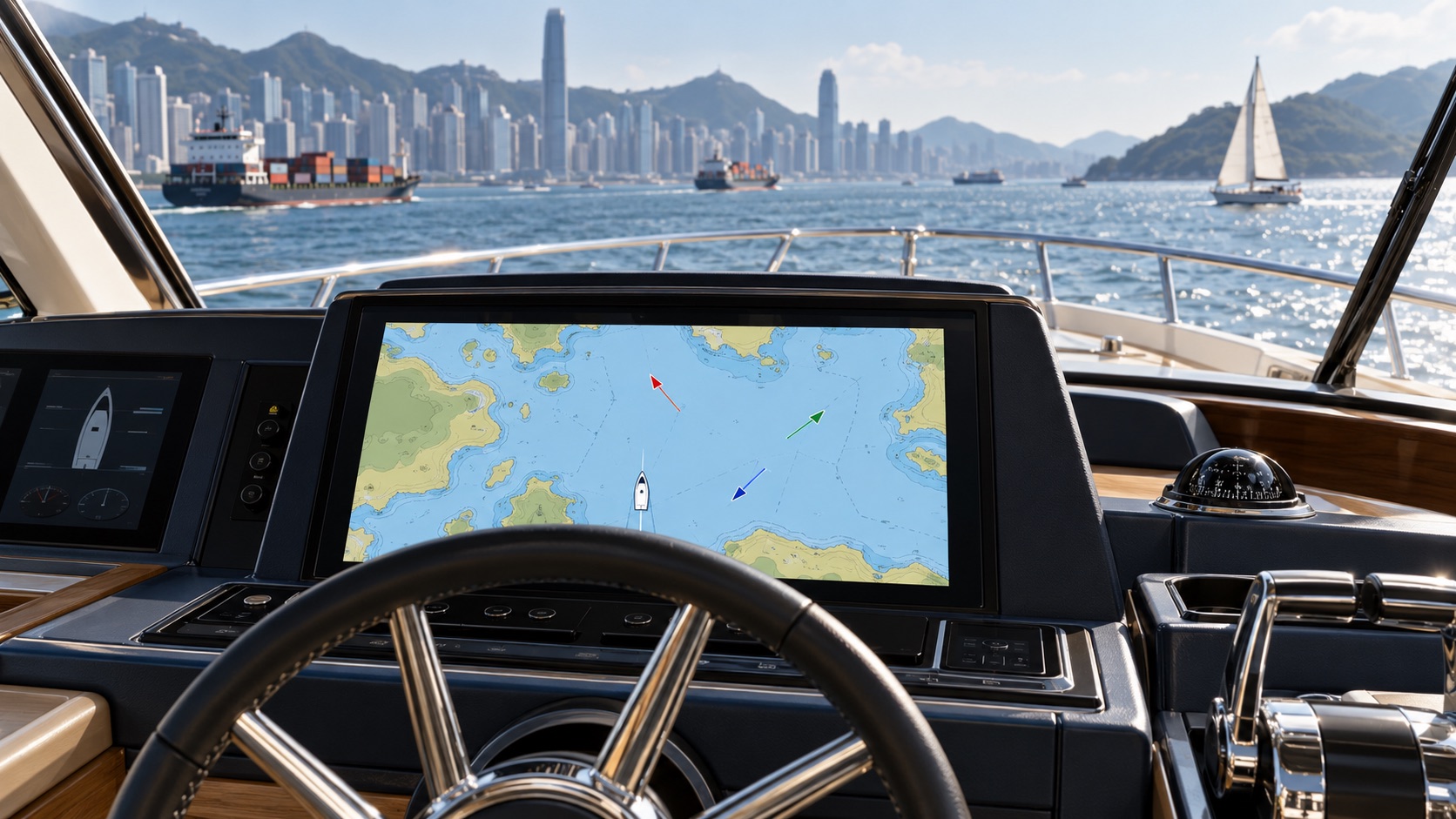
How can the small triangles on a chartplotter tell you a nearby vessel’s name, course and speed? Often, that information comes from the Automatic Identification System, or AIS. Before buying one, decide whether you want to receive nearby vessels’ information, or also broadcast information about your own yacht.
What is AIS?
AIS exchanges vessel information by VHF radio. Think of a vessel periodically sending out an electronic identity card, accompanied by information such as position, speed and course. A compatible chartplotter or display uses the received messages to show nearby vessels. The information available varies with the equipment and its configuration.[1]
AIS has a different role from GPS. GPS helps establish your own position; AIS exchanges vessel data. Radar is different again: it detects targets using reflected signals without needing them to broadcast an identity. These tools complement one another.[1][3]
Receiver or transceiver?
A receiver listens to other vessels. A transceiver can also broadcast your yacht’s information. This distinction matters more than whether the unit has an attractive screen. Seeing other boats does not prove that your equipment transmits.
| Equipment | Main role | Buying point |
|---|---|---|
| Receiver | Receives other vessels’ AIS broadcasts | Does not broadcast your position simply because it receives theirs |
| Transceiver | Receives and broadcasts configured own-vessel information | Requires correct identity data, position, antenna and power arrangements |
Class A, Class B and Class B+
Class A and Class B are transceiver categories, rather than a distinction between units with and without screens. Class A is commonly associated with vessels subject to applicable carriage requirements; many yacht transceivers are Class B. The required category must be checked against registration, use and operating area, rather than decided from yacht length alone.[2]
Within Class B, two access methods are CSTDMA and SOTDMA. Products marketed as “Class B+” generally use SOTDMA. Manufacturer examples offer higher transmit power and more frequent position updates depending on speed. Ask for the actual technology in a quotation instead of accepting “Class B” as the complete specification. It still does not guarantee every vessel will receive or notice your yacht.[2][4]
How do you choose for your yacht?
Start with the function you need
A receiver is an option to investigate if your goal is to view nearby AIS vessels on an existing chartplotter. If you also want to broadcast your own information, investigate a transceiver. Receive-only equipment is not an equivalent replacement for that function.
Consider your cruising and existing equipment
Owners using busy waters, travelling at higher speeds or planning longer passages can include Class B SOTDMA in their comparison, then assess the benefits against their needs and budget. Check the chartplotter’s exact model, connection options and display support. NMEA 2000, NMEA 0183, USB and wireless networking are different connection routes; the presence of a port alone does not establish compatibility.[4]
Include the installation in the quotation
Ask what is included for positioning, the VHF antenna or suitable splitter, cables, configuration and testing. Sharing an existing VHF antenna requires an appropriate splitter for the equipment, rather than a basic two-way connector. Antenna placement, cable losses and installation quality affect the result.[4]
Prepare these five details before requesting a quote
- Vessel registration, use, operating area and any specific equipment requirements.
- Exact models of the chartplotter, radio and existing AIS equipment.
- Whether you need reception only or own-vessel broadcasts too.
- Existing antennas, position inputs and data connections that might be retained.
- Whether installation, identity configuration, compatibility and practical receive/transmit checks are included.
The Maritime Mobile Service Identity, or MMSI, is the vessel’s radio identity and should agree with its official details. Hong Kong’s Maritime Radio (Local Vessel) Licence and Ship Station Licence on Hong Kong Ship are separate licensing categories. Check the appropriate route with OFCA for your vessel before the installer finalises the configuration.[5]
Understand the limits after installation
Vessels without operating AIS, or with incorrect information, may not appear correctly. Reception also depends on the antenna and surroundings. Online tracking services involve additional receiving networks and are not a substitute for a practical local test. Use AIS alongside visual lookout and other navigation information; it does not remove the skipper’s collision-avoidance responsibilities.[3][4]
For an equipment upgrade, send VOY your existing equipment models and cruising needs so that inspection and installation requirements can be organised. Comparing how the complete system will work is more useful than comparing hardware prices alone.
Sources
- US Coast Guard — How AIS works
- US Coast Guard — Types of AIS
- RYA — Automatic identification system
- Digital Yacht — AIT2500 specifications and installation FAQ
- OFCA — One-stop e-Application Portal and licence categories
Checked 2 November 2026. Product functions depend on the specified model and manual; foreign rules are not Hong Kong requirements.