
Shore power, a generator and a battery bank are not three sources that can simply be connected together. Shore power and most marine generators feed the alternating-current (AC) system, while the house battery bank stores direct-current (DC) energy. Source selectors, transfer equipment, distribution panels and inverter/chargers manage the changeover, distribute power and convert energy between AC and DC.
Understanding this architecture explains why a yacht can run air-conditioning and charge batteries at the berth, why a generator may be needed away from the marina, and what is draining the battery at a quiet anchorage. This article explains operating principles only. Voltage, frequency, source priority, protection and operating procedures must be checked against the yacht’s wiring diagram and equipment manuals.
Start with AC and DC
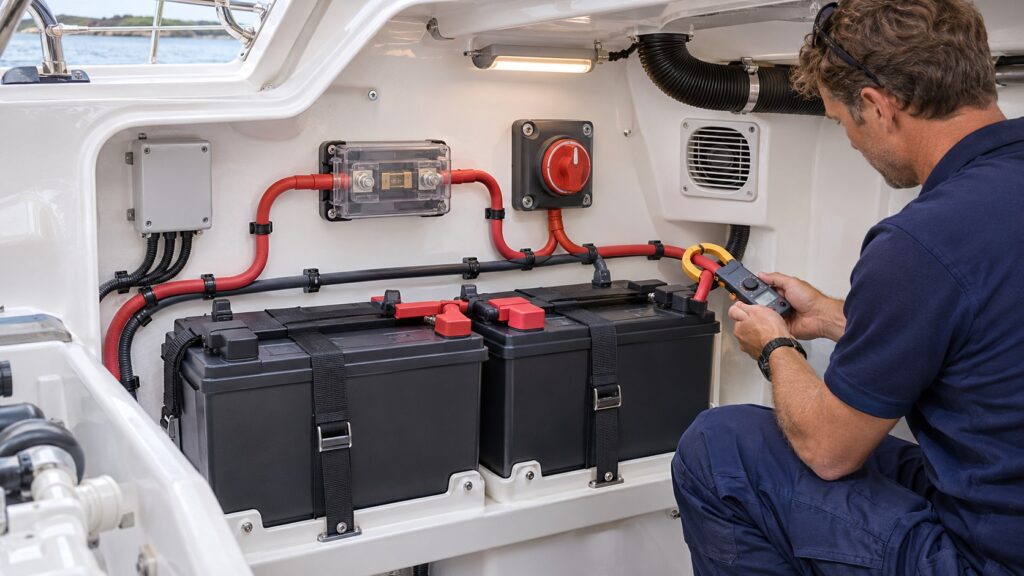
Shore power and most marine generators supply AC for loads such as air-conditioning, cooking appliances, water heaters and general outlets. Batteries supply DC for lights, pumps, electronics and control systems. An inverter converts battery DC into AC; a charger uses shore or generator AC to recharge the battery bank.
Many modern units combine an inverter, charger and transfer function in one enclosure. That does not mean every circuit shares the same capability. Whether a heavy AC load can operate from batteries still depends on inverter output, usable battery energy, the battery-management system, cabling and protection settings.

Three common operating scenarios
1. Alongside on shore power
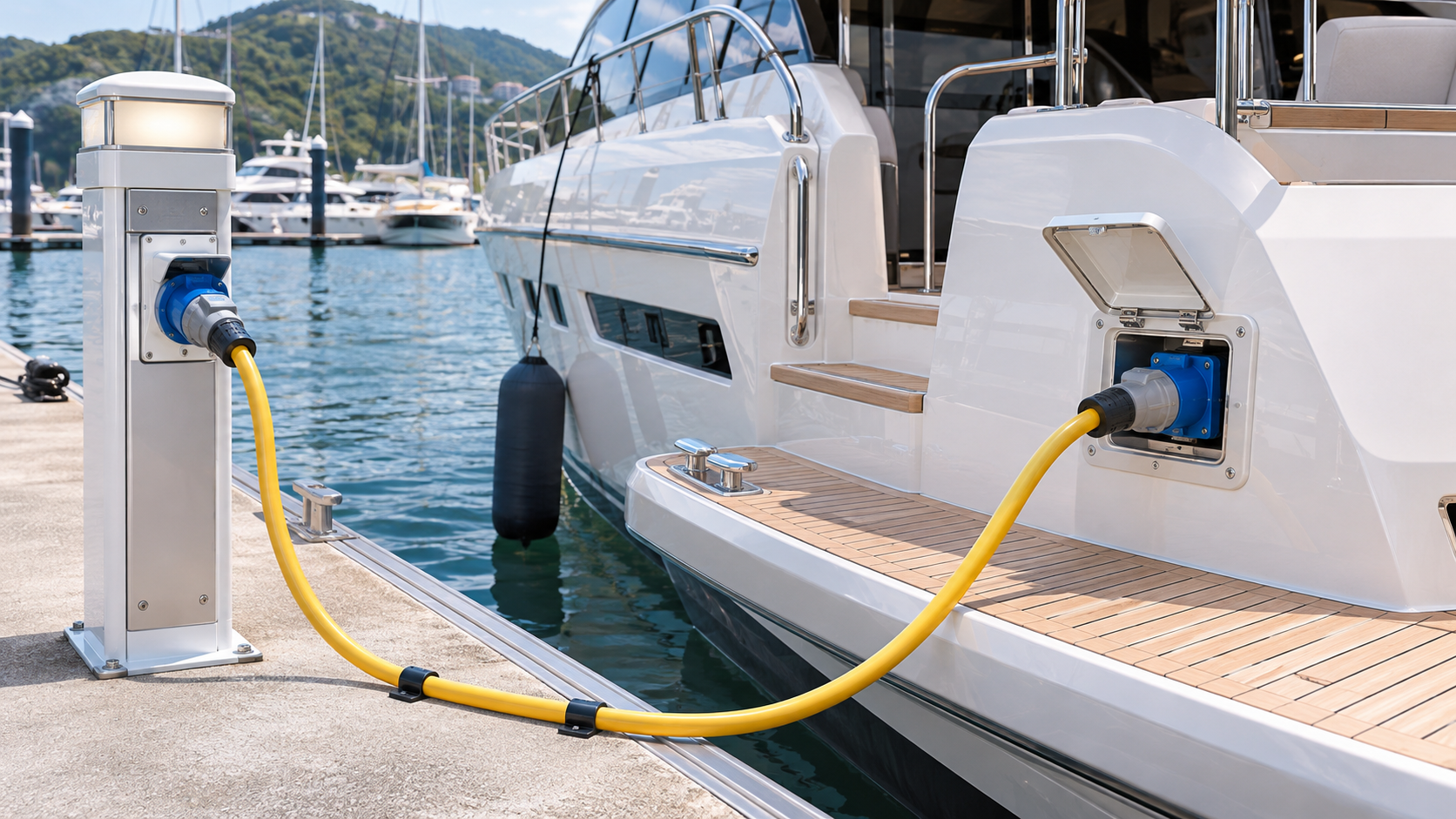
Shore power can feed the yacht’s AC bus while the charger replenishes the house bank. The marina connection still has a limit: large appliances and charging demand share the same input capacity.
2. Generator running under way or offshore
When shore power is gone and the yacht needs larger AC loads, the generator can become the AC source. Some systems wait for stable generator output before connecting loads. Some can limit charge current so that charging and air-conditioning do not overload the generator. These are equipment- and configuration-specific functions, not universal behaviour.
3. Quiet anchorage on batteries
With the generator stopped, DC loads can run directly from the battery bank, while smaller AC loads may be supplied through the inverter. This does not create energy: operating time depends on usable battery energy, load, conversion losses and battery-protection limits.
Why is a source selector or transfer switch needed?
A yacht may have shore inlets, a generator and an inverter, but their AC outputs must not be improvised into one connection. Voltage, frequency, phase and grounding arrangements must be compatible and managed by equipment designed for that purpose.
Blue Sea Systems describes rotary selectors and interlocked breakers for choosing between AC sources and preventing inappropriate simultaneous connection. Mastervolt offers automatic products that manage two or three AC inputs, depending on model. The hardware differs, but the safety objective is the same: connect the loads to one suitable source and prevent uncontrolled back-connection between sources.
Loads and charging share available capacity
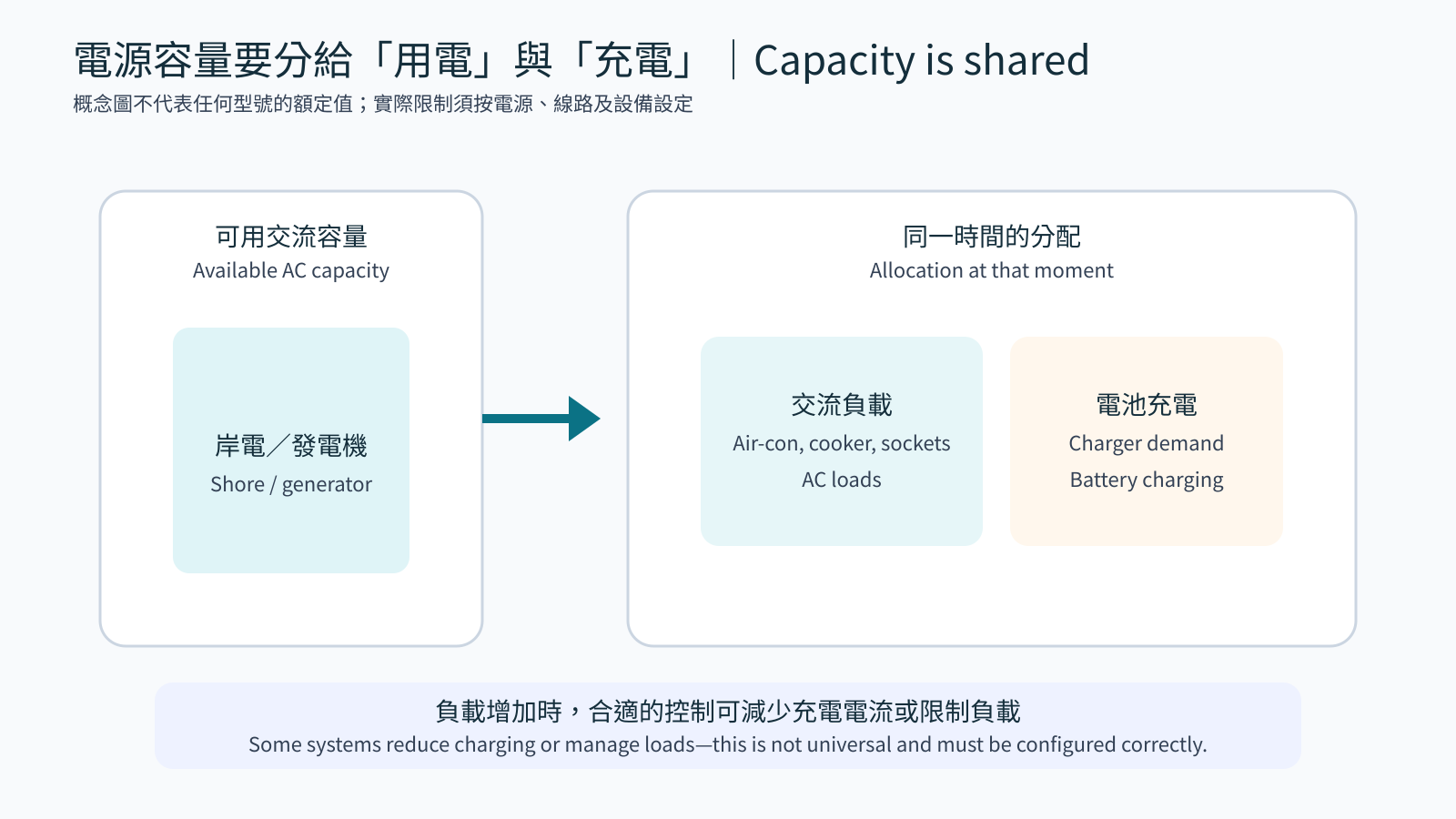
Once shore power or the generator is connected, its capacity is not reserved for appliances. The charger also draws AC to return energy to the batteries. As air-conditioning, cooking or water-heating demand rises, a properly configured system may reduce charging, manage selected loads or issue an overload warning. Without those functions, circuit breakers or equipment protection may operate.
That is why generator kilowatts or inverter watts alone cannot answer whether the whole yacht has enough power. The answer also depends on simultaneous loads, continuous and starting demand, shore-input limits, charging settings and whether the battery bank can safely supply the required DC current.
What the real equipment looks like
These four examples illustrate inverter/charging, automatic transfer, multi-source management and manual interlocking. They serve different functions and are not interchangeable merely because their enclosures look similar.
Victron Quattro 48V 5000VA 70-50A 230 VAC: Inverting, charging and transfer in one enclosure
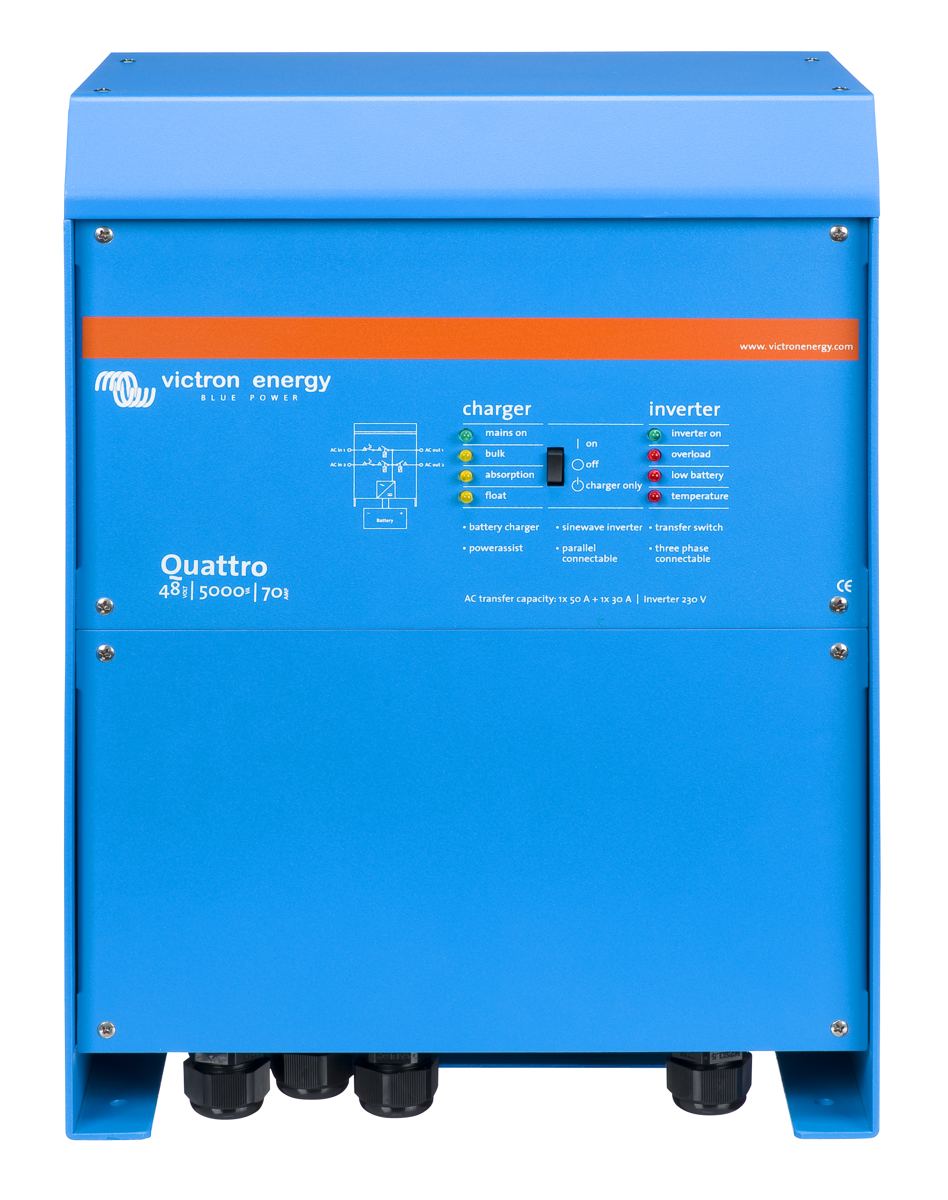
Quattro combines an inverter, charger and AC transfer function in one enclosure; the product family accepts two independent AC sources. The photograph identifies the hardware, while the architecture diagram explains the energy paths. The pictured model differs from the 120/240V model in the cited manual, so its wiring and ratings must not be assumed to match.
Mastervolt Masterswitch: An enclosed automatic AC transfer switch
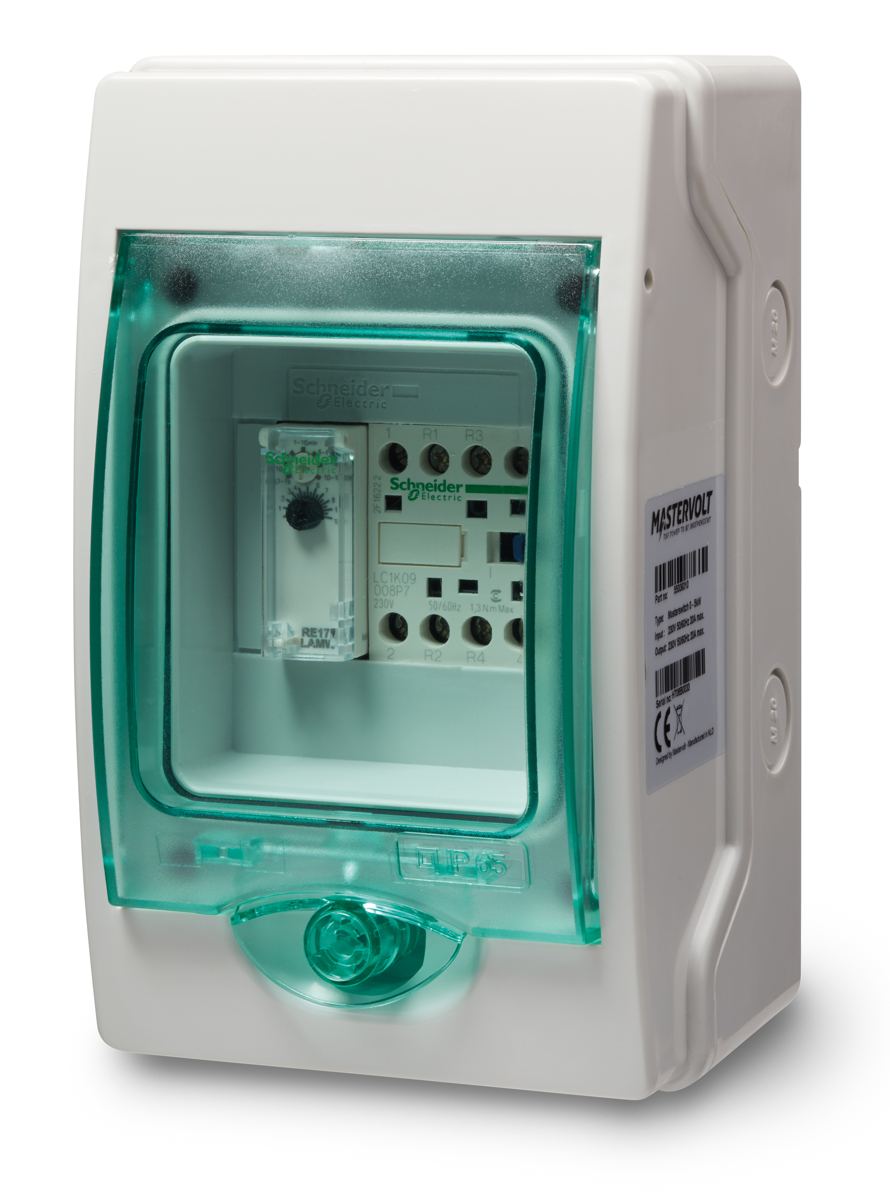
Masterswitch is an automatic AC transfer switch rather than an inverter/charger. The manufacturer lists two inputs, one output and an adjustable generator delay for the base 5 kW (230 V) model 55006010. The manufacturer’s series image shows a configuration with circuit breakers; it does not establish that breakers are included in the base model. Check the complete product code and protection arrangement.
Mastervolt Mass Systemswitch 16 kW (230 V): Managing several sources and output groups
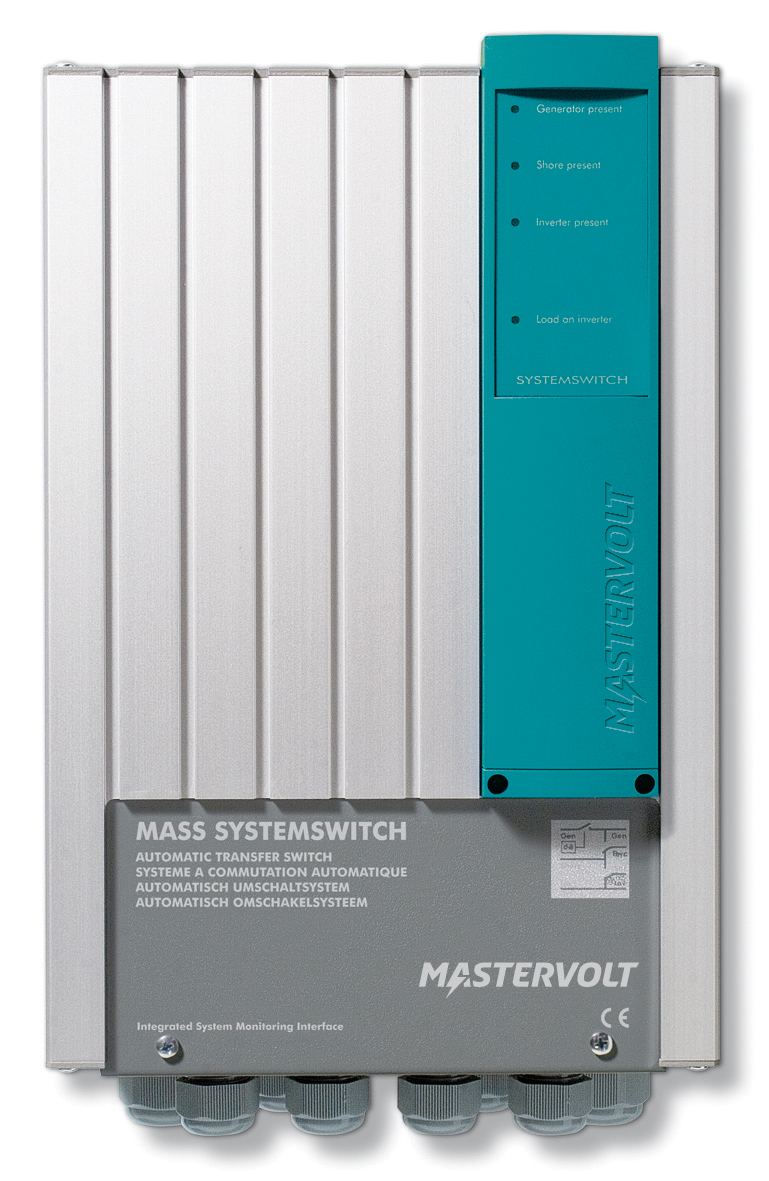
The manufacturer specifies three inputs and four outputs for the Mass Systemswitch 16 kW (230 V, 55008205), with MasterBus communication. It illustrates central transfer equipment in a more complex power architecture. Source indicators help identify available supplies; they do not mean every source feeds the loads simultaneously.
Blue Sea Systems 1209 · 230 Volt AC 2 Sources: Recognising a manual interlock on a real panel
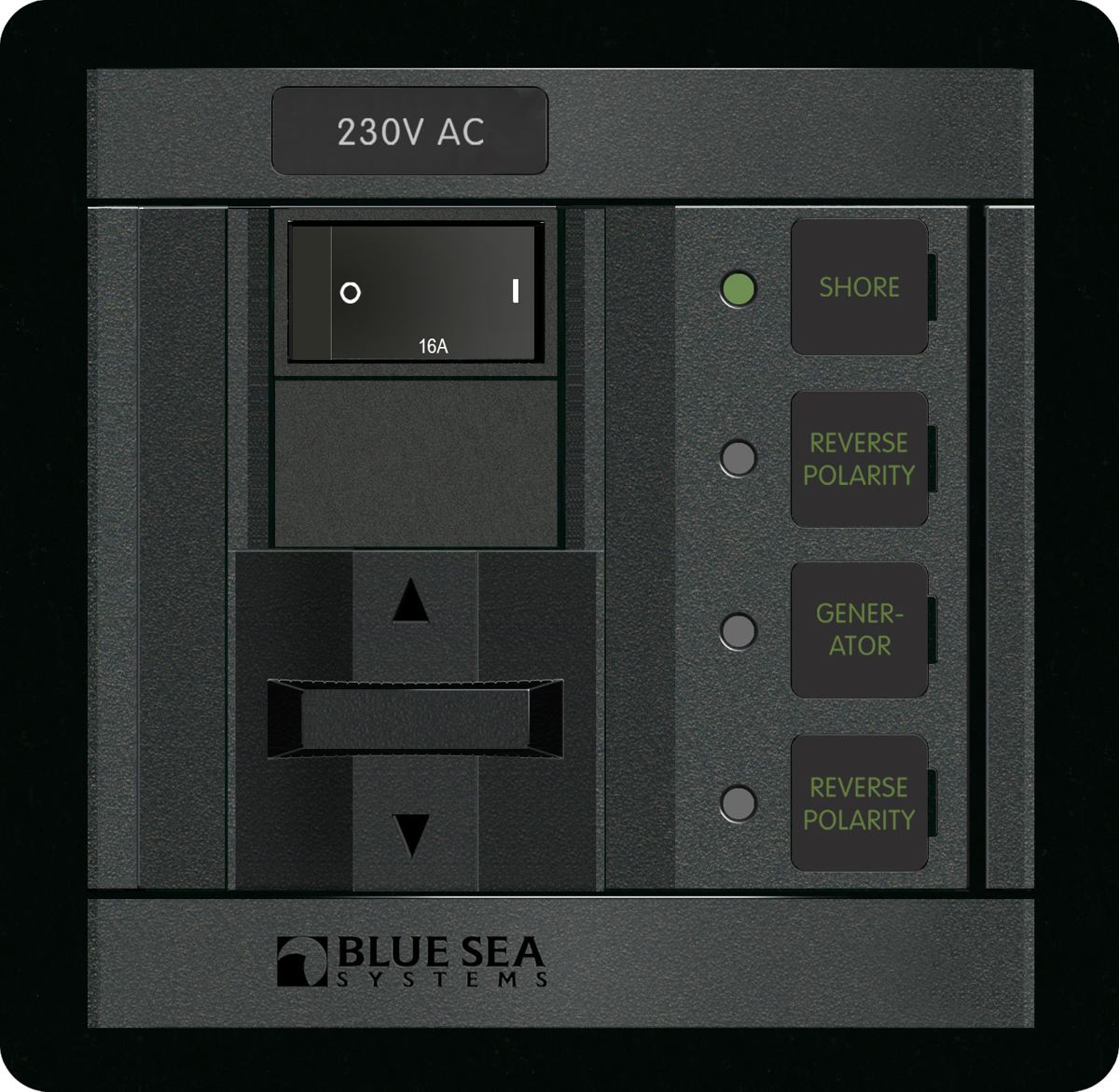
The 1209 is a 230V two-source AC panel. Its shore and generator labels, source indicators and interlock slide between the breakers make the selection function visible. The manufacturer says the slide prevents multiple AC sources from being connected simultaneously. This is different from automatic transfer and does not add the capacities of the two supplies.
| Equipment | Main role | What to recognise |
|---|---|---|
| Quattro | Inverter, charger and AC transfer | Several functions in one enclosure; verify the model. |
| Masterswitch | Automatic transfer between two AC sources | Verify inputs, outputs and breaker configuration. |
| Mass Systemswitch 16 kW | Three inputs and four outputs | Source indication and system communication do not mean all sources feed together. |
| Blue Sea 1209 | Manual two-source AC selection | Shore/generator labels and the interlock slide. |
What should an owner check?
- Find the yacht’s wiring diagram: identify the relationship between shore input, generator, inverter/charger, house bank and distribution panels.
- Identify the changeover method: manual rotary selector, interlocked breakers or automatic transfer? Do not assume every load moves seamlessly to batteries when shore power is removed.
- Read source and load indications: at the berth and after generator start, check voltage, frequency, current and source status against the manuals.
- Know which loads are inverter-fed: many yachts keep air-conditioning, water heaters or other heavy loads off the inverter bus to avoid rapid battery discharge.
- Record abnormalities: repeated trips during transfer, warm plugs or cables, burning smells, unstable frequency, interrupted charging or unusual battery temperature.
If changeover is unstable, protection trips repeatedly, a shore connector shows heat damage, or batteries and the inverter alarm under load, stop experimenting and ask a technician familiar with marine AC and DC systems to test the installation against the wiring diagram.
Summary
Shore power and the generator are normally AC sources; the battery is DC energy storage; the inverter/charger connects those two worlds. Source-selection equipment decides which AC source feeds the loads, distribution and protection limit each circuit, and appliances share capacity with charging. Once an owner understands this architecture, the switchboard becomes easier to read—and it is clearer when the issue is operating procedure and when a technician is needed.
Voy can help organise a yacht’s power-system information and coordinate inspection or maintenance for an identified vessel, subject to confirmed scope. Visit Voy.hk for current services.
Sources
- Victron Energy, Quattro 5k 120/240V Manual: two AC inputs, transfer, inverter operation and safety for the named models; accessed 6 November 2026.
- Victron Energy, Wiring Unlimited: AC wiring: distribution, protection, bypass and grounding concepts; accessed 6 November 2026.
- Mastervolt, AC transfer systems: examples of two- and three-input automatic transfer products; accessed 6 November 2026.
- Blue Sea Systems, AC Source Selection: rotary and interlocked-breaker source-selection concepts; published 19 March 2008, accessed 6 November 2026.
- Blue Sea Systems, AC Ground Faults and ELCI/GFCI: ground-fault protection background; published 27 April 2009, accessed 6 November 2026.