
Is northbound yacht maintenance worth it? The answer should not be based only on whether a Mainland yard looks cheaper than a Hong Kong option. For Hong Kong yacht owners, the real question is whether the project scope justifies a cross-boundary move, whether the quotation is transparent, whether the work process can be recorded clearly, and whether clearance, insurance, documents and the return plan are properly managed. Based on VOY’s northbound maintenance experience and a real owner case shared by Mr Wong, this guide gives owners a practical way to decide before committing.
Short answer: going north only for a lower price may not be worth it
When many owners first hear about taking a Hong Kong yacht north for maintenance, the first question is usually whether it will be cheaper than doing the work locally. That is understandable, but it is not a complete decision framework. Yacht maintenance is not the same as buying a simple product. It is an engineering project involving navigation safety, hull condition, machinery reliability, yard scheduling, customs or port-clearance documents and payment confirmation.
If an owner moves the yacht north purely to chase a lower labour cost or a lower line-item quote, without a clearly defined scope, photo records, old-part retention, variation approval and handover checks, the owner may actually take on more risk. On the other hand, if the project size is suitable and there is a team managing documents, quotation breakdown, yard communication, progress reporting and final handover, northbound maintenance can be a serious option worth considering.
When does northbound maintenance make sense?
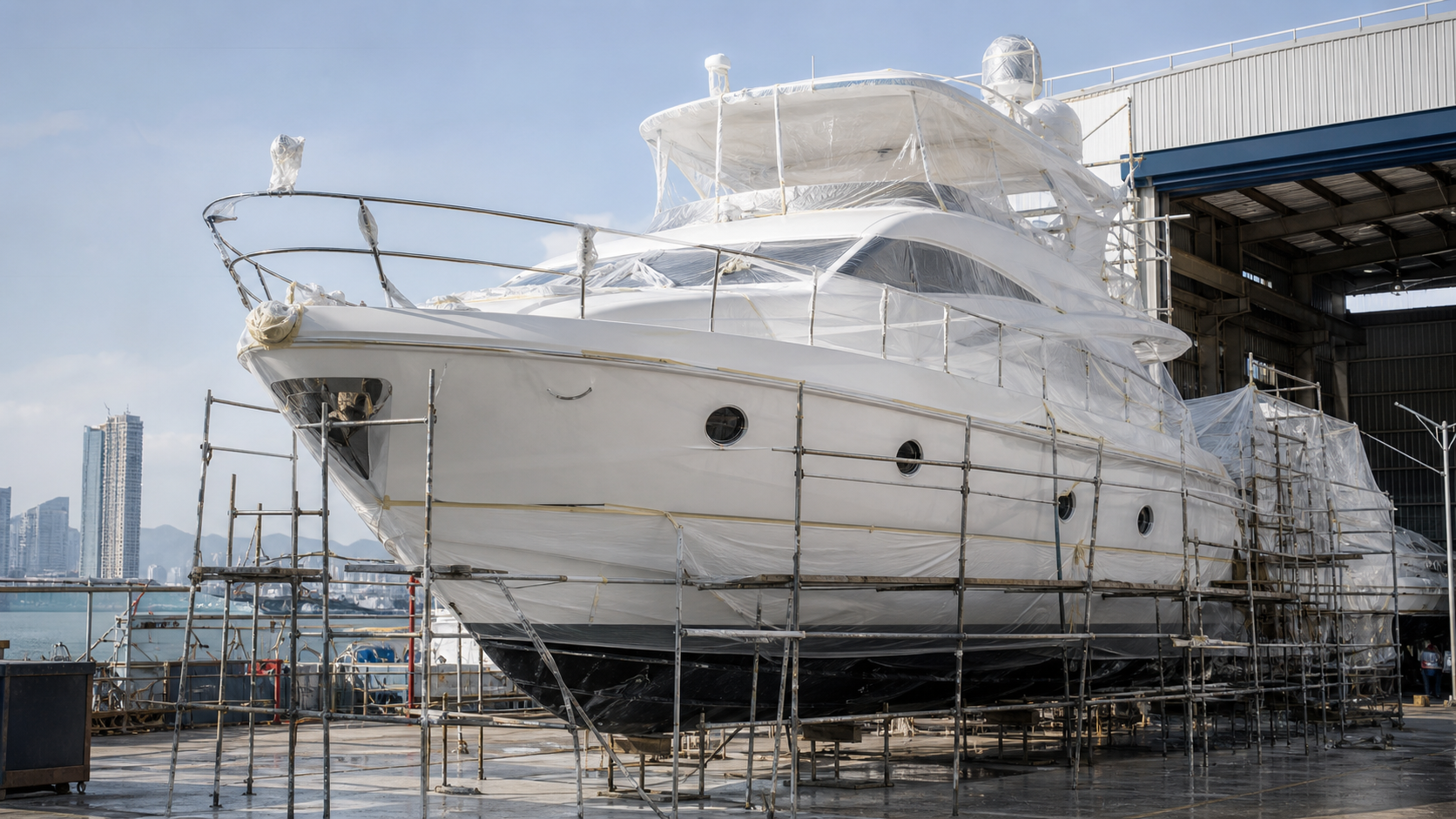
Not every yacht and not every repair item should be moved north. It usually makes more sense when the project involves multiple work items, requires haul-out or inspection space, or needs a more coordinated yard environment.
- Hull or exterior works: for example haul-out inspection, fibreglass work, hull exterior work, bottom treatment or painting.
- Multiple maintenance items handled together: such as machinery, bottom work, pumps, cooling, batteries, steering, interior or other repair items.
- Longer work duration: not a same-day minor repair, but a project that needs more time and multiple trades.
- Hong Kong space or scheduling is not ideal: the owner wants more room, a clearer workflow and a more complete project arrangement.
- The owner needs third-party coordination: the owner may not have time to attend the yard every day and wants someone to follow up photos, old parts, quotation items and progress.
By contrast, if the job is a very small same-day repair, an urgent replacement, or the vessel itself is not suitable for cross-boundary navigation, handling the work in Hong Kong may be more sensible. A professional recommendation should not simply push every owner to move the yacht north. It should first assess the vessel condition, passage risk, document readiness and project scale.
Real owner case: Mr Wong’s complete northbound maintenance experience
The following video records a real VOY northbound yacht maintenance case, in which Hong Kong yacht owner Mr Wong shares his experience. He discusses document preparation, clearance arrangement, photo updates after the yacht arrived in Zhuhai, quotation transparency and his overall view of the maintenance process.
The value of this interview is not that every yacht will have the same cost or identical process. The value is that it shows what owners should look for: whether the process is visible, whether the quotation is itemised clearly, and whether someone is managing cross-boundary paperwork and yard communication on behalf of the owner.
If the video does not load immediately, open it directly on YouTube: Mr Wong’s full northbound yacht maintenance interview
4 takeaways from Mr Wong’s case
- The quotation must be itemised: the owner should know what is essential, what is optional, which items are charged, and which items are not charged.
- The maintenance process should be visible: photos, old parts, damage locations and progress should be reported regularly, not only after completion.
- Company-owned vessels need earlier document preparation: authorisation, insurance, operator details and clearance documents are often more complex than for privately held vessels.
- Whether it is worth going north depends on management: price is only one part of the decision; the bigger issue is who coordinates, confirms, follows up and handles handover.
Quotation transparency: owners should not look only at the total price
The most common misunderstanding in northbound maintenance is comparing only the total quote. What matters in yacht maintenance is not simply whether the total number is low, but whether every work item has a clear reason, location, necessity, charging basis and risk if not carried out.
A useful maintenance quotation should at least help the owner separate three types of items:
- Safety-critical items: work that affects navigation safety, machinery reliability, clearance risk or the ability to return safely.
- Recommended maintenance items: items that may not stop the yacht from operating immediately, but delaying them may increase future cost or risk.
- Appearance or comfort items: items mainly related to exterior finish, interior comfort or non-urgent improvements, which can be decided according to budget.
One useful point in Mr Wong’s case is that he valued a quotation with line-by-line clarity, rather than a vague statement of the total cost. For owners, an itemised quotation makes the decision more rational: which items must be done, which can wait, and which are desirable but not essential.
Visible work records: photos, old parts and variations should be documented
When the owner is not physically at the yard, the biggest concern is usually not whether the yard has started work, but whether the owner knows what has actually been done. That is why the management focus of northbound maintenance is to make the process visible.
A reasonable workflow includes:
- take photos when a problem is found, showing the location and condition;
- explain whether the issue is safety-related, maintenance-related or cosmetic;
- keep records or photos of old or damaged parts when they are replaced;
- quote and explain variation items before seeking owner approval;
- provide before-and-after records, testing notes and handover checks after completion.
These records are not only for peace of mind. They become useful maintenance history for future servicing, resale, insurance discussion or follow-up repairs. For long-term yacht ownership, the maintenance record is part of the vessel’s management file.
Documents and clearance: company-owned vessels should prepare early
Taking a yacht north for maintenance is not simply a matter of whether the vessel can physically move. Owners should allow time for vessel documents, ownership identity, company authorisation, insurance, operator details, entry and exit arrangements, receiving arrangements at the destination and the return plan.
In general, owners should organise the following before the move:
- Vessel documents: Certificate of Ownership (COO), Operating Licence (OL), vessel name, vessel number, length, class and expiry dates.
- Insurance information: third-party cover, navigation area, maintenance period, Mainland waters and whether yard movement is covered.
- Owner or company authorisation: if the yacht is company-owned, confirm company authorisation, authorised signatory and appointment arrangements.
- Operator and crew details: coxswain or operator certificate, identity documents, contact details and passage arrangement.
- Maintenance purpose and receiving arrangement: define the maintenance scope, yard or marina receiving arrangement, expected timing and return plan.
Company-owned yachts often require an extra layer of authorisation and documentation. If missing information is only discovered just before departure, the whole maintenance schedule may be delayed. This is why northbound maintenance should start with an intake and document check, not with last-minute paperwork.
Hong Kong yards vs Mainland yards: not either-or, but project matching
Hong Kong yards have the advantage of proximity, easier communication and owner access. Minor repairs and urgent work can often be handled more directly in Hong Kong. Mainland yards may offer advantages in space, haul-out arrangement, concentration of trades and the ability to handle larger projects.
Therefore, the real question is not whether Hong Kong is better or Mainland is better. The question is where this particular project should be done. Owners should consider:
- Does the work require larger space or a longer work period?
- Does it involve multiple trades that need coordinated scheduling?
- Is the yacht suitable for cross-boundary movement, and is the passage risk manageable?
- Will someone provide on-site updates and communicate with the yard after arrival?
- Are documents, clearance, insurance and the return plan already arranged?
If these conditions are not prepared, northbound maintenance may not be worthwhile even if the quote appears attractive. If the project scale and process management are suitable, it can give Hong Kong owners another serious maintenance option.
VOY’s role: not just introducing a yard, but managing the cross-boundary process
What many owners really need is not simply an introduction to a yard. They need someone to integrate information between the owner, the yard, documents, quotation, work process and return plan. The yard speaks in technical terms; the owner cares about safety, cost, timing and outcome. Clearance paperwork follows a process; the owner needs to know what to prepare, what may be missing and whether repeated follow-up will be required.
VOY’s role in this type of northbound maintenance arrangement can be understood as project management and communication between the owner and the yard:
- preliminary review of vessel condition and maintenance scope;
- assistance with pre-departure documents and information;
- translation of yard quotations into owner-readable line items;
- follow-up on work photos, old parts and progress;
- assistance with variation items and risk confirmation;
- handover, payment records and return-plan coordination after completion.
In other words, whether northbound maintenance is worth it is not only a yard question. It is a process-management question. When the owner can clearly see where the yacht is, what is being done, why it is being done, how much it costs and when it will finish, northbound maintenance becomes a controllable project rather than a leap of faith.
7 questions before deciding to move the yacht north
- Is my yacht suitable for cross-boundary movement? Are the engines, cooling, batteries, bilge pumps, fuel system and communication reliable?
- Are the COO, OL, insurance, operator documents and company authorisation ready?
- Is the maintenance scope large enough to justify clearance, time and coordination costs?
- Is the quotation itemised clearly enough to separate essential, recommended and optional items?
- Will the yard or coordination team provide photos, old-part records, progress updates and before-and-after records?
- If additional work is discovered, will it be quoted and explained before owner approval?
- After completion, will there be testing, handover notes, invoice or record keeping, return arrangement and maintenance recommendations?
Conclusion: value depends on whether the process is controllable
Northbound yacht maintenance is not simply a question of cheap or expensive. If an owner goes north only for a low price, but the quotation is unclear, the work process is invisible and the documents are unmanaged, the owner may not truly benefit. If the project size is suitable, the quotation is itemised, the work process is recorded, and cross-boundary documents and return arrangements are followed up properly, northbound maintenance can be a worthwhile option for Hong Kong yacht owners.
The most important test is whether the owner still has information and decision control. When the process is transparent, the risks are manageable and responsibilities are clear, northbound maintenance is not merely “going to the Mainland to fix the boat”. It becomes a managed yacht engineering project.
Authoritative references
- Hong Kong Marine Department: Pleasure Vessels
- Hong Kong Marine Department: Licensing for Local Vessels FAQ
- Hong Kong Marine Department: Local pleasure vessel operators
- Hong Kong Marine Department: Entry and Clearance Procedures for Non-Convention Vessels / Visiting Pleasure Vessels PDF
- Hong Kong Marine Department: Public Forms
Further reading

Want to assess whether your yacht is suitable for northbound maintenance?
WhatsApp: +852 5904 8455
Email: [email protected]
WeChat ID: voyyacht